A climbing workout is about an hour of climbing, followed by 10 to 25 minutes of strength work. Three times a week, and each session has a different job.
Below is one example: a strength week from a Build block, the part of a training cycle where the goal is to get stronger. The mix changes from block to block. The logic does not. Every session, exercise and number is further down.
The climbing workout week at a glance
| Day | Job of the session | On the wall | Off the wall | Time |
|---|---|---|---|---|
| Monday | Movement | 10 to 14 moderate problems, easy traversing | Push-ups, rows, hanging leg raises, optional legs | 80 min |
| Tuesday | Rest | - | A walk or mobility, nothing that pulls | - |
| Wednesday | Limit | 5 limit boulders, 3 tries each | Pull-ups, dips, shoulders, wrists | 90 min |
| Thursday, Friday | Rest | - | Easy cardio or mobility on one of the two | - |
| Saturday | Power endurance | 4x4s, easy traversing | Bicycle crunches, back extensions | 80 min |
| Sunday | Rest | - | - | - |
How to read the week
The days are movable. The order is not. The limit session needs fresh fingers, so it comes after a rest day. Power endurance leaves the deepest fatigue, so it goes last.
Effort is out of 10 and describes how hard it feels today, not how the problem is graded. 3 is an easy chatting pace. 7 is working but in control. 9 means one or two more moves and you are off. On strength exercises, 8/10 means you could do two more reps.
Every session opens with the same 20 minutes: easy problems, a little harder every two or three climbs. Fingers are tendon and pulley. They do not wake up in four minutes the way your legs do, and a short warm-up is the cheapest way to hurt them.
Why every session has one job
When someone asks me for a good climbing workout, they usually already have one. Ten minutes of easy problems, then the hardest thing on the wall until the fingers stop closing, then pull-ups because pull-ups feel like training. Three times a week, the same session.
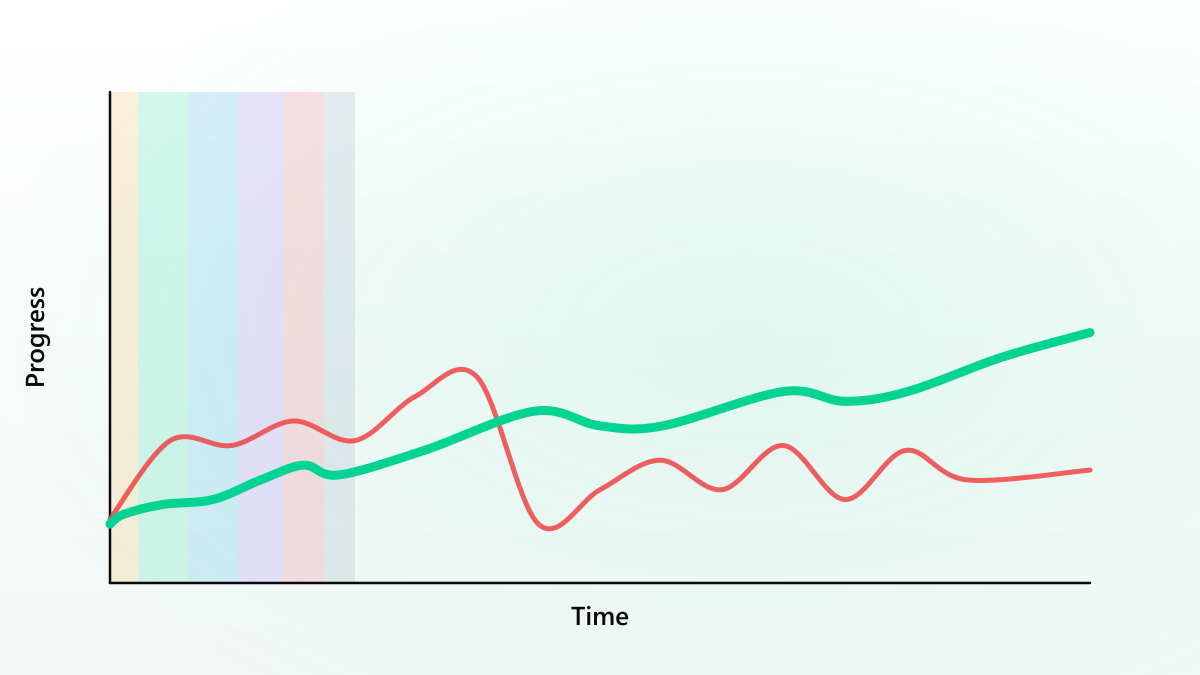
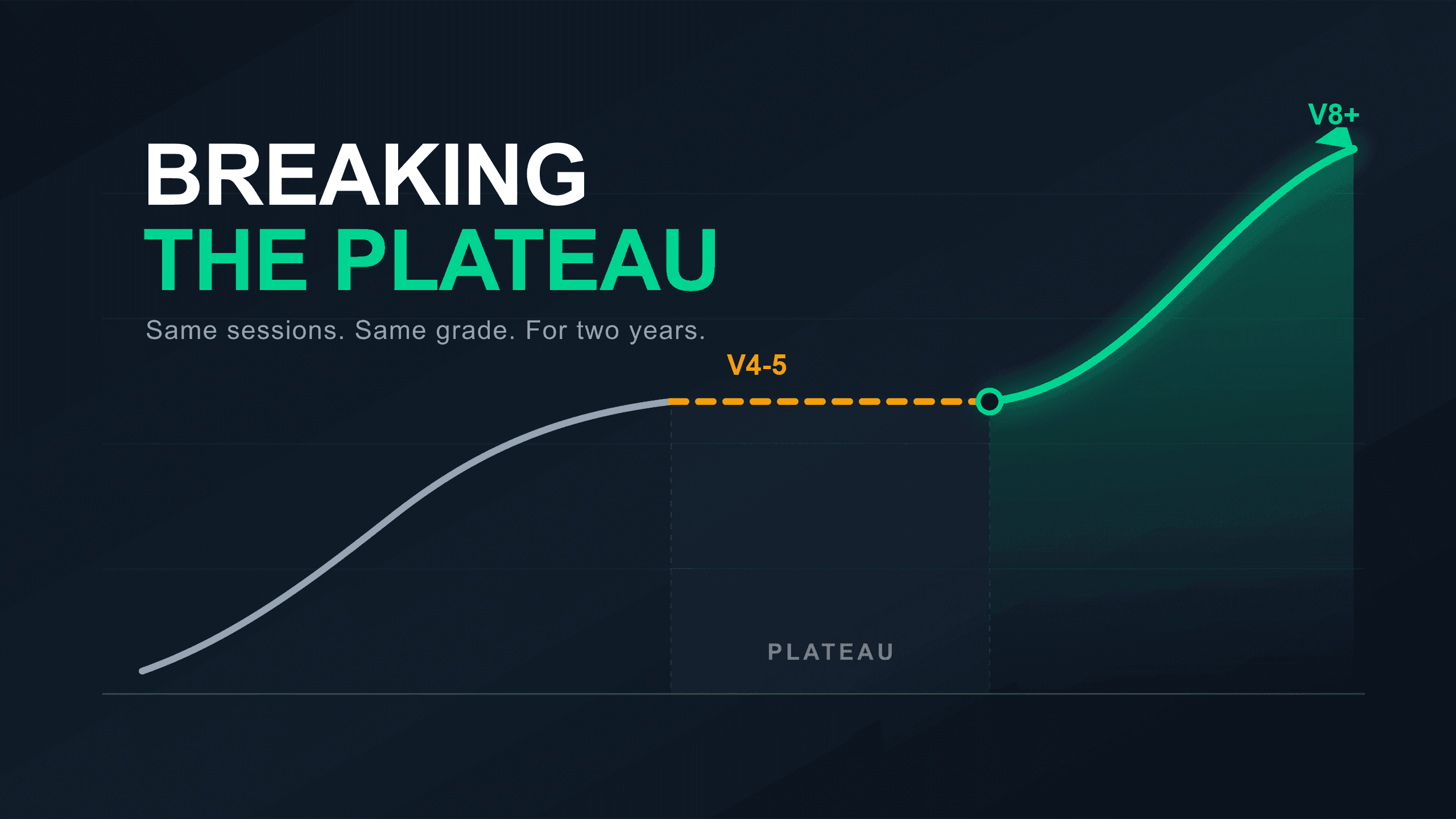
The body adapts to the job you give it, and only to that job. Movement, limit strength and the ability to keep going when you are pumped are three different qualities. Give all three sessions the same job and you get the classic plateau: strong for one move, empty for four.
If you cannot name the job of today's session, you are not training. You are just climbing hard and hoping.
Session 1: movement and general strength
This is the session climbers skip because it does not feel like anything. You finish it able to climb again. That is the point: you are building movement and volume, and you only build those when you are not fighting for your life on every move.
| Part | What you do | Dose | Effort |
|---|---|---|---|
| Warm-up | Easy problems, a little harder every two or three | 20 min | 3-6/10 |
| Climbing | Moderate problems you can flash or send on the second try | 10 to 14 problems, 1-2 min between them | 6-7/10 |
| Climbing | Easy traversing on big holds, no pump allowed | 2 rounds of 3 min on, 5 min off | 2-3/10 |
| Strength | Push-ups | 3 sets of 10-15, 90 s rest | 7/10 |
| Strength | One-arm dumbbell row | 3 sets of 8-10 per arm, 90 s rest | 7/10 |
| Strength | Hanging knee or leg raises | 3 sets of 8-12, 60 s rest | 7/10 |
One rule makes this session work: silent feet and no readjusting. The moment you start slapping and repositioning, you are done with that problem. You are practicing quality, and you cannot practice quality while tired.
Session 2: limit bouldering and pulling strength
Limit work is short, hard, and separated by rests that feel too long. Four minutes between problems is not laziness. Maximum force needs a recovered nervous system, and that takes minutes, not seconds.
| Part | What you do | Dose | Effort |
|---|---|---|---|
| Warm-up | Easy problems, building to two or three a grade or two below your limit | 20 min | 3-7/10 |
| Climbing | Limit boulders you can send in three or four tries on a good day | 5 problems, 3 tries each, 2 min between tries, 4 min between problems | 9/10 |
| Strength | Pull-ups, fast up, controlled down | 4 sets of 4, 2-3 min rest | 8/10 |
| Strength | Dips, or push-ups with your feet raised | 3 sets of 6-10, 2 min rest | 8/10 |
| Strength | External rotations with a resistance band | 2 sets of 15 per arm | 5/10 |
| Strength | Reverse wrist curls with a light dumbbell | 2 sets of 15 | 6/10 |
Pick problems you can send in three or four tries on a good day, not projects you have been failing for a month. A limit boulder you never touch teaches your fingers nothing. It just teaches you to fall.
Two rules. When you can no longer do moves you did on your first try, the limit part is over. A sharp pain or a pop in a finger ends the session. If it still hurts days later, see a physical therapist.
For pull-ups, choose the load so that six reps would be your limit, then do four and stop with two in the tank. If six is easy, add weight with a belt. If six is out of reach, do sets of two or three at bodyweight. A band is only for those who cannot do more than three.
The pushing, shoulder and wrist work at the end is not a bonus. Pulling without pushing is how shoulders and elbows start talking to you in year two.
Session 3: power endurance and core
This is the session that decides whether you can link the moves you already have. Most climbers who fall at the top of a boulder or on the last hard clip are not weak. They are strong for six seconds and empty at twenty. If you want a number for that gap, critical force gives you one.
| Part | What you do | Dose | Effort |
|---|---|---|---|
| Warm-up | Easy problems, longer than usual, two sets of scapular pull-ups, ending on two you can flash | 20 min | 3-6/10 |
| Climbing | 4x4s: four problems two or three grades below your limit | 4 rounds, straight from one problem to the next (60 s at most), 3 min between rounds | 6/10 rising to 9/10 |
| Climbing | Easy traversing on big holds | 2 rounds of 3 min on, 5 min off | 2-3/10 |
| Strength | Bicycle crunches | 3 sets of 20, 45 s rest | 7/10 |
| Strength | Back extensions, holding a plate once 12 gets easy | 3 sets of 12, 60 s rest | 6/10 |
Rest only as long as it takes to chalk up and walk to the next one. A minute is the ceiling, not the target. The first round should feel easy. The last one should not. If you fall in round two, the problems were too hard and you turned a power endurance session into a failure session.
How to make the same three sessions progress
The sessions stay the same for four weeks. The load does not.
- Week 1: the tables as written, one grade easier. It should feel comfortable.
- Week 2: the same volume at your normal grades.
- Week 3: the hardest week. One extra round or problem on the main climbing, the hardest problems of the block.
- Week 4: half the volume, no limit attempts, climb for fun. This is when the adaptation shows up.
The next block starts a small step above where this one started. Not above where it ended. That is the mistake that turns a training block into an injury.
Adjusting the week
Only two days a week. Keep the limit session and the movement session: one hard day, one easy day. You lose the 4x4s and keep the volume that builds technique.
You climb routes, not boulders. The jobs stay the same. Movement is easy mileage on routes. Limit is two or three routes near your best, 10 to 15 minutes apart. Power endurance is double laps two or three grades below your best: a minute between laps, 10 minutes between pairs, four to six pairs.
You climb outside on weekends. A day on rock is a hard day, whatever you planned. It takes Saturday's place. Never add it on top.
What to do and what not to do in a climbing workout
Most of the value in a session is decided before you touch a hold.
Do
- Warm up for twenty minutes, every session, even the easy one.
- Decide the job of the session before you walk into the gym.
- Put the hardest climbing first, right after the warm-up, while you are fresh.
- Time your rests. A phone timer is the cheapest coach you will ever hire.
- Finish with the strength block: ten to twenty-five minutes, not an hour.
Do not
- Make every session a limit session. That is the fastest way to a plateau.
- Rest by feel. Sixty seconds feels like three minutes when you are tired.
- Lift heavy before you climb. Climb first, lift after.
- Stack a hangboard on a full week. Replace something instead.
- Judge a session by how wrecked you feel. Fatigue is a cost, not a result.
Climbing workout questions people actually ask
How often should you do a climbing workout?
Two or three times a week, with at least one full rest day between sessions. Three is the sweet spot for most people with a job. In your first months, two is often better, because fingers, skin and elbows adapt slower than the muscles that feel tired.
Should you lift weights on climbing days or on rest days?
On climbing days, after the climbing. A rest day with a heavy gym session in it is not a rest day for your fingers. If you train legs, add them at the end of Monday, not on Tuesday: tired legs the day before the limit session cost you every high step. Deadlifts load your grip too, so use straps or keep them moderate.
Do you climb first or lift first?
Climb first. Climbing is the skill you came for, and skill needs a fresh body and a clear head. Weights go after, when technique no longer matters and you only need force. The one thing that can go before the hard climbing is a short activation, after the easy part of the warm-up and never cold: three or four explosive pull-ups, or a few short hangs at half effort. It wakes the system up without draining it.
How much of the workout should be climbing and how much should be exercises?
Roughly three quarters on the wall, the rest off it. In an 80 to 90 minute session that is about an hour of warm-up and climbing, then 10 to 25 minutes of pulling, pushing and core. Flip that ratio and you get a climber who is strong in the gym and still stuck on the same problem.
How long should a climbing workout be?
80 to 90 minutes, including the warm-up. Past two hours the quality of every move drops, and you are practicing tired movement, which is exactly what you do not want to get good at.
Can you climb two days in a row?
Yes, if the second day is easy. Two hard days back to back load the same tendons twice before they have repaired anything. Your muscles recover in a day, your fingers and skin do not, and they are what decides how long you can keep training.
Can you do a climbing workout at home?
The strength half, yes: a pull-up bar and a pair of dumbbells cover every exercise in the tables above. Climbing itself, no, because movement is a skill and skills need the real surface. A home session is a good third session. It is a poor first one.
Do you need a hangboard for this?
Not in your first year or two, and not while V4 is your limit. The limit session already loads your fingers close to maximum, on real holds, in real positions. A hangboard becomes useful when climbing alone stops giving you enough finger load, or when you need to train fingers without the rest of the wear that climbing brings. When that day comes, here is how to start hangboard training safely.
What is a good climbing workout for beginners?
The movement session from this week, twice a week, strength block included. Leave limit bouldering and 4x4s alone for your first six to twelve months: your fingers and elbows are still building tissue capacity, and there is more to gain from learning to move than from pulling harder on holds you cannot yet use well.
The part that decides everything
A good workout is easy to design and hard to repeat. The climbers who move up are not the ones with the cleverest session. They are the ones who did a reasonable session on a Wednesday in November when it was cold and nobody would have noticed if they had stayed home.
Structure buys you that. When you know the job of today, you stop negotiating with yourself in the changing room.
And you? Can you name the job of your next session?
Want these three sessions built around your level, your schedule, and your gym?
Get Your Personalized Training Plan