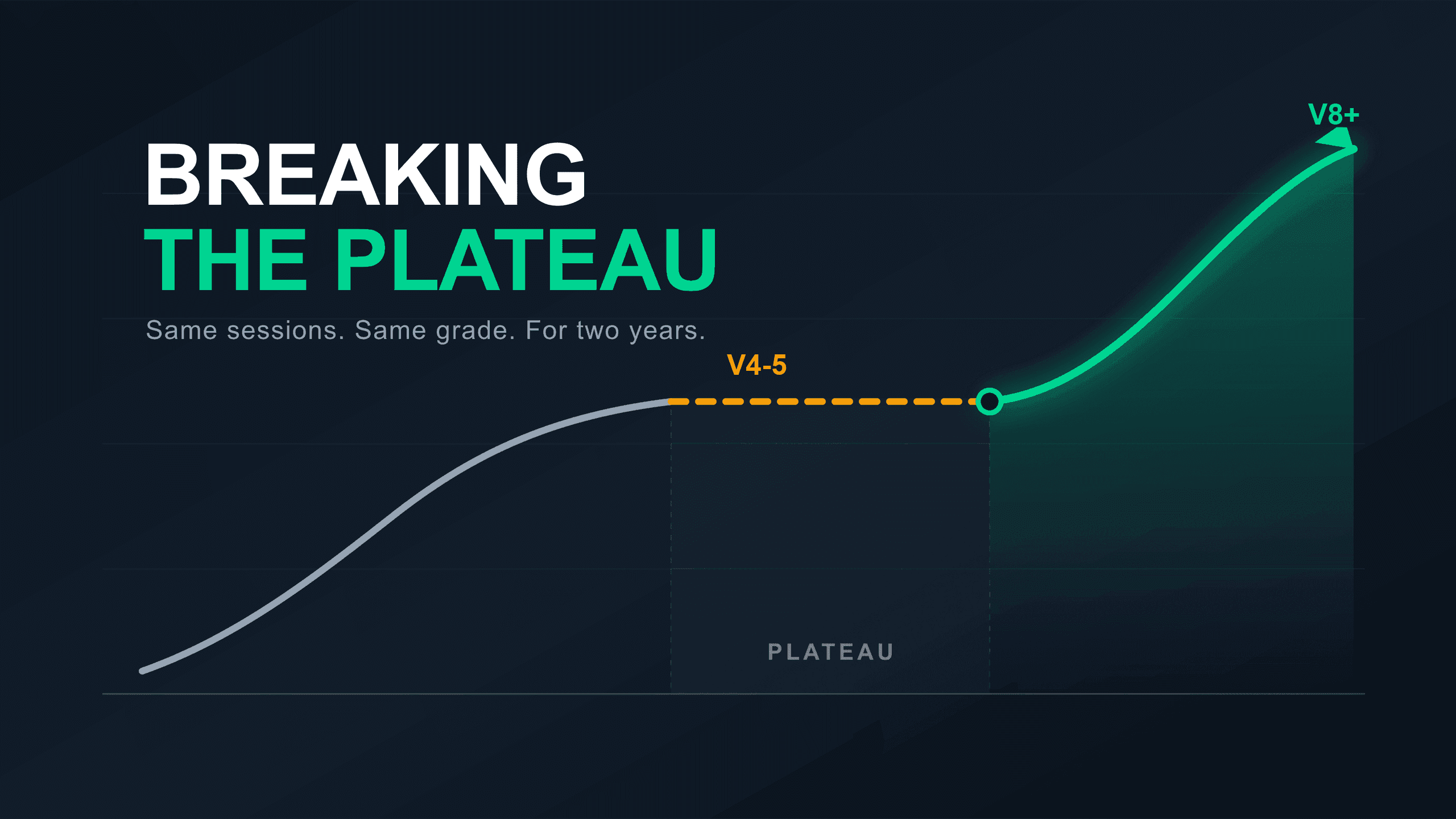
A bouldering plateau at V4 is the most common place to get stuck, with V3 close behind, and almost nobody gets stuck there for the reason they assigned themselves. A lot of climbers have come through our gym over the last nine years. When someone tells me they have been at V3 or V4 for a second year, they almost always open with the same sentence: "I think my fingers are weak."
That can be true. It can equally well not be true.
Why V4 is where climbing stops paying for effort
From V0 to V3, you get better by showing up. Any climbing works as a stimulus, because everything is new. Your body has never done this before, so it adapts to all of it at once. Show up twice a week, and the grades come.
Then it stops. Not because you got weaker. The beginner adaptation is simply spent, and what is left are the systems that only answer to a specific stimulus aimed at them. Where this happens depends on the base you walked in with. A former gymnast can land on V6 before it hits. Someone who sat at a desk for ten years can meet the same wall at V2. The grade on the plateau tells you about your starting point, not about your ceiling.
This is the exact moment where most people start guessing. And they mostly guess fingers.
Mistake 0: we are creatures of habit
We are used to one rule: to get the next grade, push harder. Give it more attempts. Go do more pull-ups. But what worked on the last level does not have to work on the next one.
Picture each level as a door you have to open, and every door needs its own key. One key does not open all of them. And your key is not the same as the next climber's key, because the two of you did not start from the same place.
And if the plateau is already hitting your motivation, I wrote about that separately: how motivation affects your results.
Mistake 1: you diagnosed your fingers because fingers are what you feel
When you come off a hold, the sensation lives in your hand. The hand opened. So the hand is the problem. It is the most available explanation, and availability is not evidence.
Here is what I see on most V4 falls: the foot was on the foothold but never got weighted, the centre of mass stayed away from it, and the body handed the fingers a load they were never meant to carry. The finger opened last. It was not the cause. I looked at how force actually reaches your fingertips in short-term and long-term factors affecting grip strength.
Your fingers might genuinely be weak. The problem is that you decided they were without ever measuring anything.
We see this gap every time we map a climber against the five systems that set a grade. Among climbers stuck between V3 and V6, movement comes out as the weakest system in about half of the profiles. Strength, the thing almost everyone wants to train, is the actual limiter in fewer than one in five.
The weakest system among climbers stuck at V3-V6
Share of profiles where each system comes out lowest when all five are mapped together.
And yet nine out of ten of the same climbers ask for a strength plan.
Note what I am not saying. Finger strength matters, and hangboards work. Sometimes fingers really are the weak link, and some climbers at V5 sit well below what the grade usually asks for. For them a hangboard is exactly the right tool. The point is that this is something you can measure instead of guess.
If you want to measure it, read this part slowly
I have to be careful here, and so do you. Injuries are the most common complaint I hear from climbers at exactly your grade, and a maximum-effort finger test is the single most dangerous thing in this article. Done at the wrong moment, the test does not measure the injury. It causes it.
So the test is not for everyone reading this. It is for you only if all of these are true:
- your fingers have not hurt in the last three months, not even a small tweak
- you have been climbing regularly for at least six months
- you can already hang a 20 mm edge on your own bodyweight, half crimp, for ten seconds, without it feeling like a fight
If any one of those is missing, close this section. Your answer is not on a hangboard yet, and the honest reading of that is good news: it means there is easier progress available to you somewhere else.
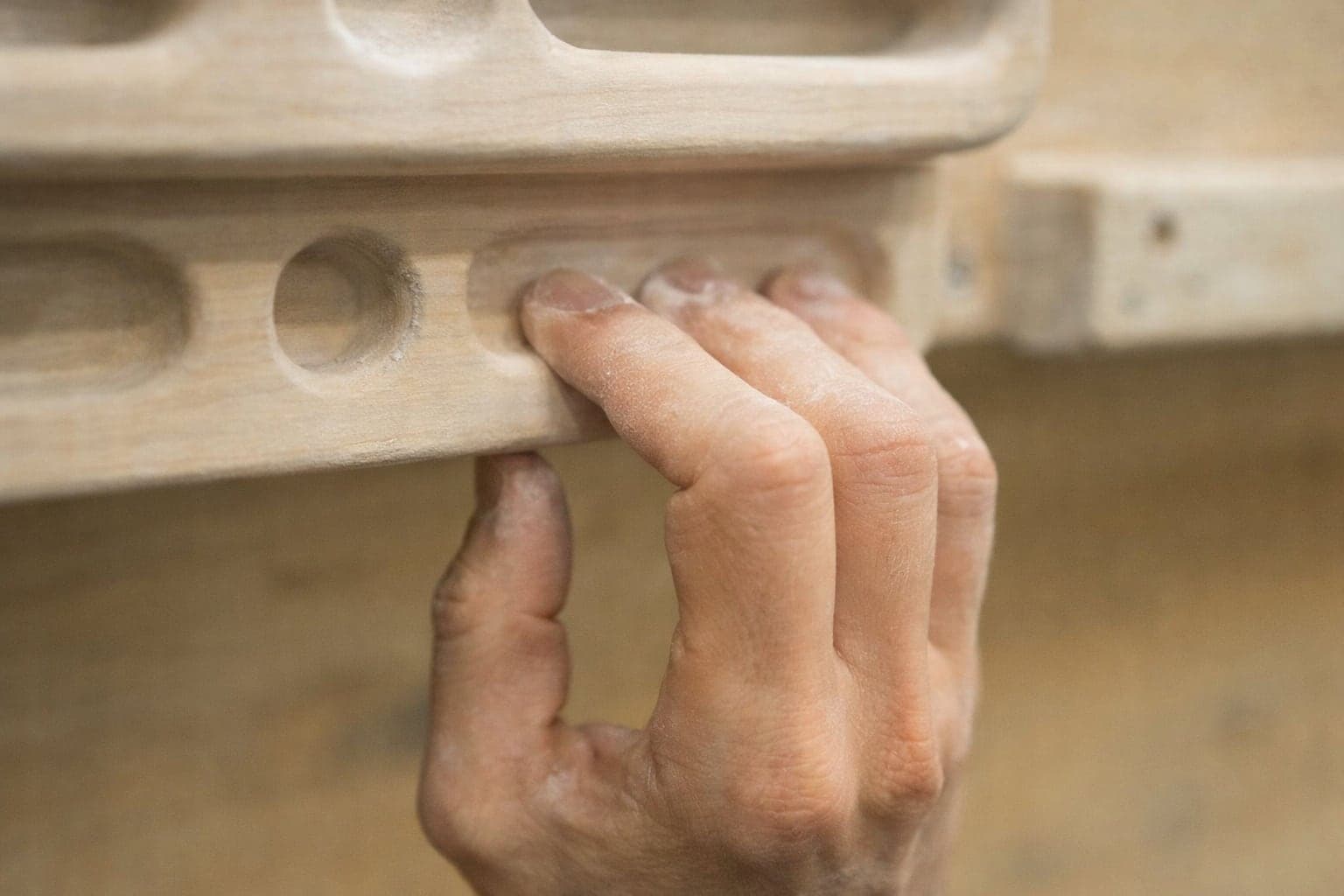
If all three are true: warm up properly first, twenty minutes minimum, fingers included, never cold and never after a hard session. Half crimp, 20 mm edge, seven to ten seconds. Add weight in small steps across several sets, and stop the moment anything in a finger feels sharp, hot or simply strange. You are not hunting failure. You are looking for a number to write down.
A number on its own tells you nothing. It starts to mean something next to the typical spread at your grade, and the spread is wider than most climbers expect:
Put your number into our finger strength calculator and you will see exactly where you sit for your grade, sex and discipline: behind it, inside the typical band, or already ahead. If you are ahead, that is the best outcome of this whole test. It means the hangboard was never going to move your grade, and your limiter is one of the other four systems.
If you are in any doubt about whether this test is for you, it is not for you. Nothing at V4 is worth a pulley.
And if you hang close to bodyweight and still climb V5, that is not bad news. It means your movement is carrying you, and the ceiling is somewhere else entirely.
The price of the wrong diagnosis is the wrong treatment. You buy a hangboard, you take a protocol from a video, and you train a system that never asked for help. Meanwhile the real limit sits untouched.
Mistake 2: you climb, but you do not train
Talking to climbers who train in our gym, and running surveys with more than 500 people, the answers come back in the same words every time. "I just climb, without a plan." "I kinda do whatever." "I don't know if what I'm doing is working."
Three sessions a week for two years is around 300 sessions. That is a lot of time to spend without knowing what any single one of them was for. Climbing is the sport. Training is deciding what today is supposed to change. More of the first does not produce the second.
The test is simple and slightly uncomfortable. Ask yourself what last Tuesday's session was for. If the answer is "I climbed," you have found something.
Mistake 3: you climb what you are already good at, and progress starts where the failures are
One climber wrote a sentence I still think about: "I'm sending too many boulders. I forget to struggle."
Walk into any gym and watch where people go. They go to their style. If you are strong on crimps, you gravitate to the crimpy problems, you send them, you feel good, you go home. Your crimping gets slightly better. Your slopers stay exactly where they were in 2024.
Your grade is set by your worst style, not your best one.
That is why the number does not move even though the sessions feel productive. Sending feels like progress, but it is feedback about ability you already had. Progress lives in the problem you fall off eight times.
Mistake 4: every session is a hard session
Injuries were the single most common answer. Not technique, not fingers. Injuries, from nearly half of everyone who replied. And the pattern was always the same loop: get hurt, recover, feel strong, push, get hurt again.
One of them put it exactly: "Every time I feel strong, I get injured again."
You do not get stronger during a session. You get stronger between sessions. Training is a question you ask the body, and recovery is when it answers. If every session is at your limit, you keep asking and never wait for the reply. The adaptation you are working for happens on the days you think you are wasting.
Three hard sessions a week is a plan. Three hard sessions with nothing easy between them, all loading the same tissue, is three chances to get hurt.
Mistake 5: you cannot see your own technique
Technique was the second most common answer, and it has a cruel property: it is invisible from the inside. You feel like you set the foot precisely. From the ground it was a slide and a re-adjust. You feel like you were close to the wall. On video your hips are twenty centimetres out.
Everyone has a professional bias. Mine is movement, because I have spent years watching how people move, and I simply like what the human body turns out to be capable of. And even if you come back to the same move for ten sessions, it can still fall apart.
Film two attempts on your project. Not for social media. Watch the feet. Most V4 climbers find their answer in the first thirty seconds, and it is not about their hands.
Here is what I look for when I watch someone at this grade. Four things, and they show up in almost every session.
You set the foot, then you fix the foot
Watch how you put a foot on a foothold. Then watch what happens in the next second. You adjust it. You slide it. You bump it twice until it sits where you were aiming in the first place.
Each correction costs energy, and that is the smaller part. The bigger part is what it tells your head. Every re-adjustment is a message that you are not quite in control, and on a climb that already feels insecure, three of those are enough to make you rush the next move. Then you rush the placement. Then you fix it again.
I am not talking about the deliberate adjustment on a bad foothold or a smear. That is a choice. I mean the corrections you did not plan, the ones that come from aiming badly. The fix is boring and it works: set the foot exactly where you want it the first time, even when it feels slow. Practise it in your warm-up, on problems far below your limit, where precision costs you nothing.
Precision is not something you find at your limit. It is something you bring there.
You reach for the next hold before you finish the move you are in
Halfway through a rock over you see the next hold and you go for it. You are extended, your weight hangs off your hands, the hold feels terrible, and you decide the hold is the problem.
It usually is not. You reached from a position you had not finished building. On a slab or a vertical wall, this is almost always the fix: finish the rock over, stand up on the foot, and only then look up. The same hold is now closer, your weight is on your feet instead of your fingers, and it feels like a different hold. On steep ground the rule bends, because there you often have to keep moving to keep the momentum. But at V4, most of the time, you are reaching too early.
Most bad holds at V4 are good holds taken from the wrong place.
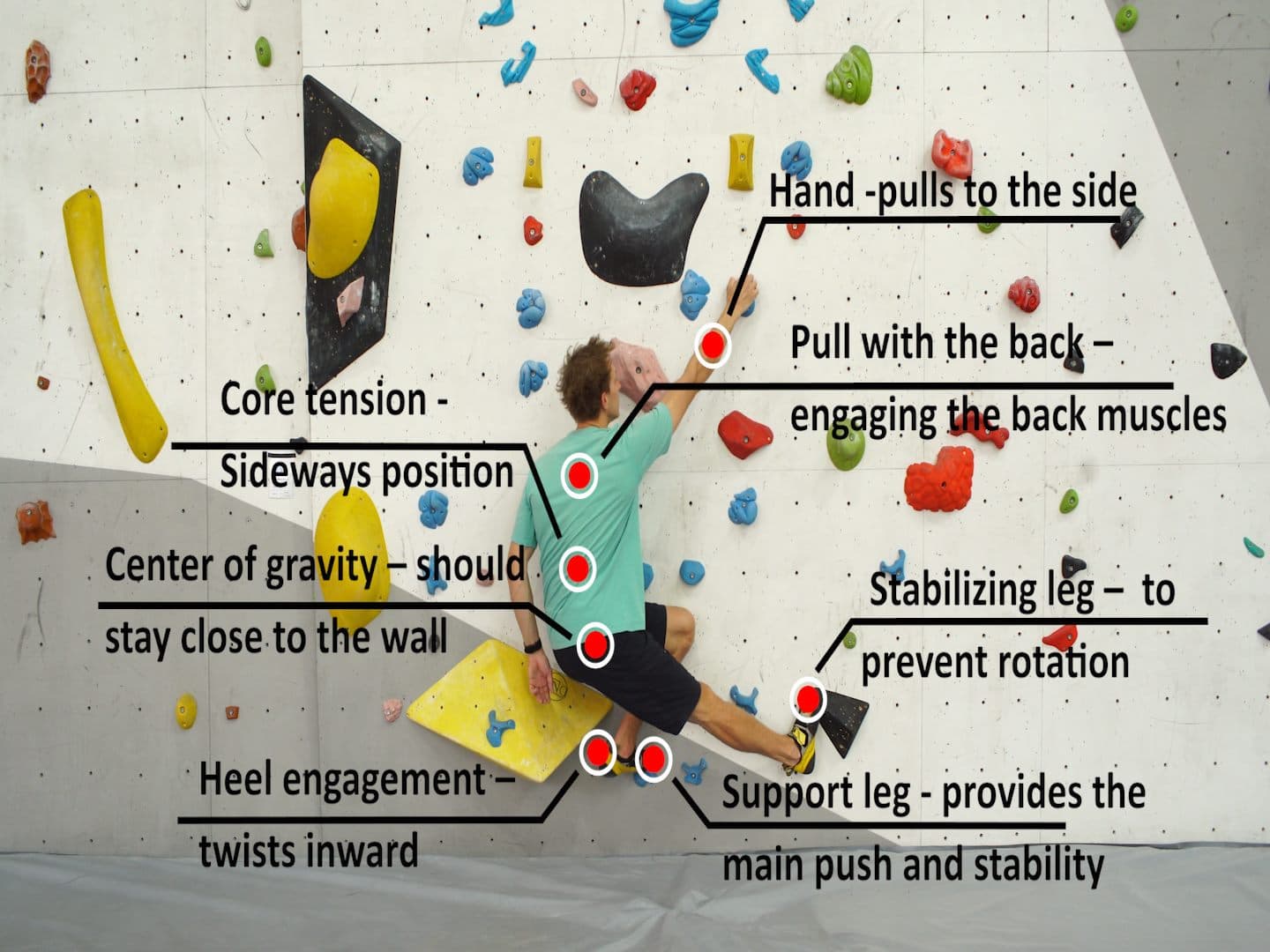
Body position
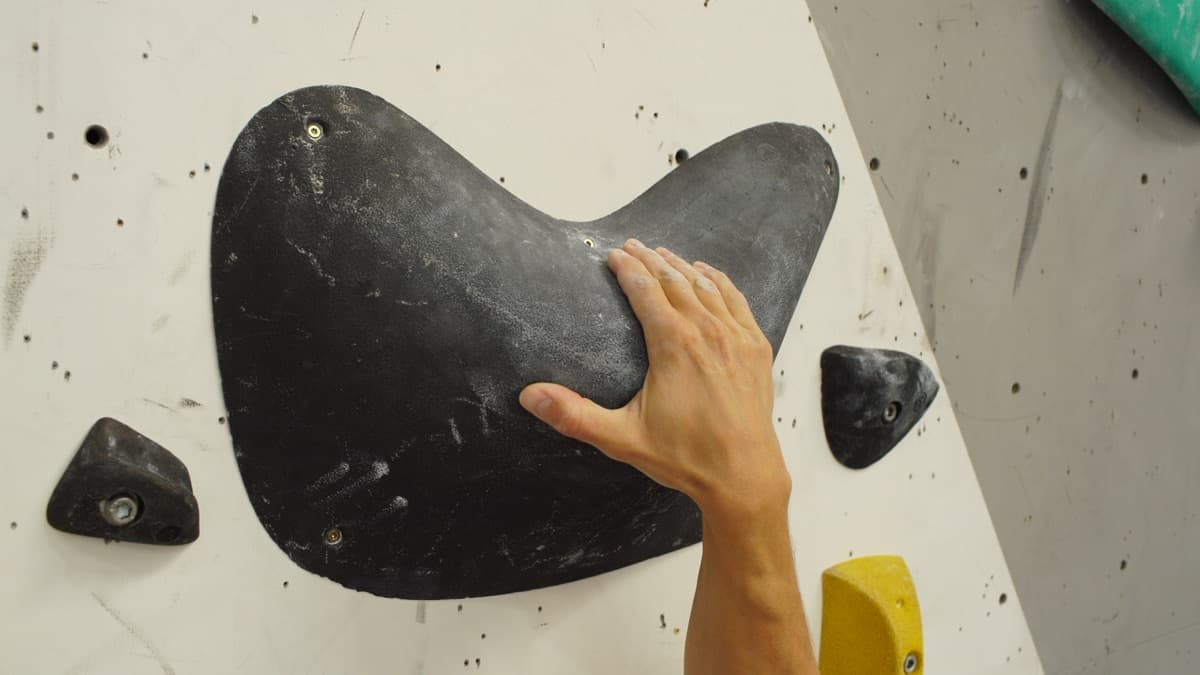
Most holds are only bad from the wrong body position. The hold did not change, your position relative to it did, in the literal sense. The work is not gripping harder, it is getting your hips and feet to the place where that angle becomes usable. Fight for the position, not for the hold.
On dynamic moves you skip the part that makes the move possible
On anything jumpy, climbers at V4 put everything into the catch. The catch is the last event in the chain, and by rushing to it you skip what produces it: standing up into the position, the timing, the weightless moment where the reach actually exists.
Break it into parts in practice. Stand up into the position and drop off it, five times, without touching the target hold at all. Then stand up and tap it. Then stand up and catch it. Add one step at a time and do not rush: it saves the skin on your fingers and raises your chance of doing the move.
When you finally go for it, aim at the hold. Your eyes belong on the target. What changes is not where you look, it is that you built the position first instead of throwing from nothing.
What to do with this
Look at what these mistakes point at. They are not one problem wearing different clothes. They point at five different systems: how you move, how you are built physically, how you decide and hold focus, how you recover, and how specifically you prepare for what you climb.
A plateau usually means one of them is the main limiter. The other four are not useless, they just give you less right now, and while the main one stays untouched the grade will not move. That is why more effort feels like it goes nowhere. You are pushing on the four doors that were already open.
So the work is not "train harder." The work is finding which of the five is yours. For most people stuck anywhere from V3 to V5, it is not the one they assumed.
Two years at a grade is not a talent problem. It is a diagnosis problem, and then a plan problem.
That is the work we do here. We look at where you actually stand across all five systems, find the one holding you back, and build the plan around it.
Find out which of the five is your weak link.
Get Your Personalized Training Plan