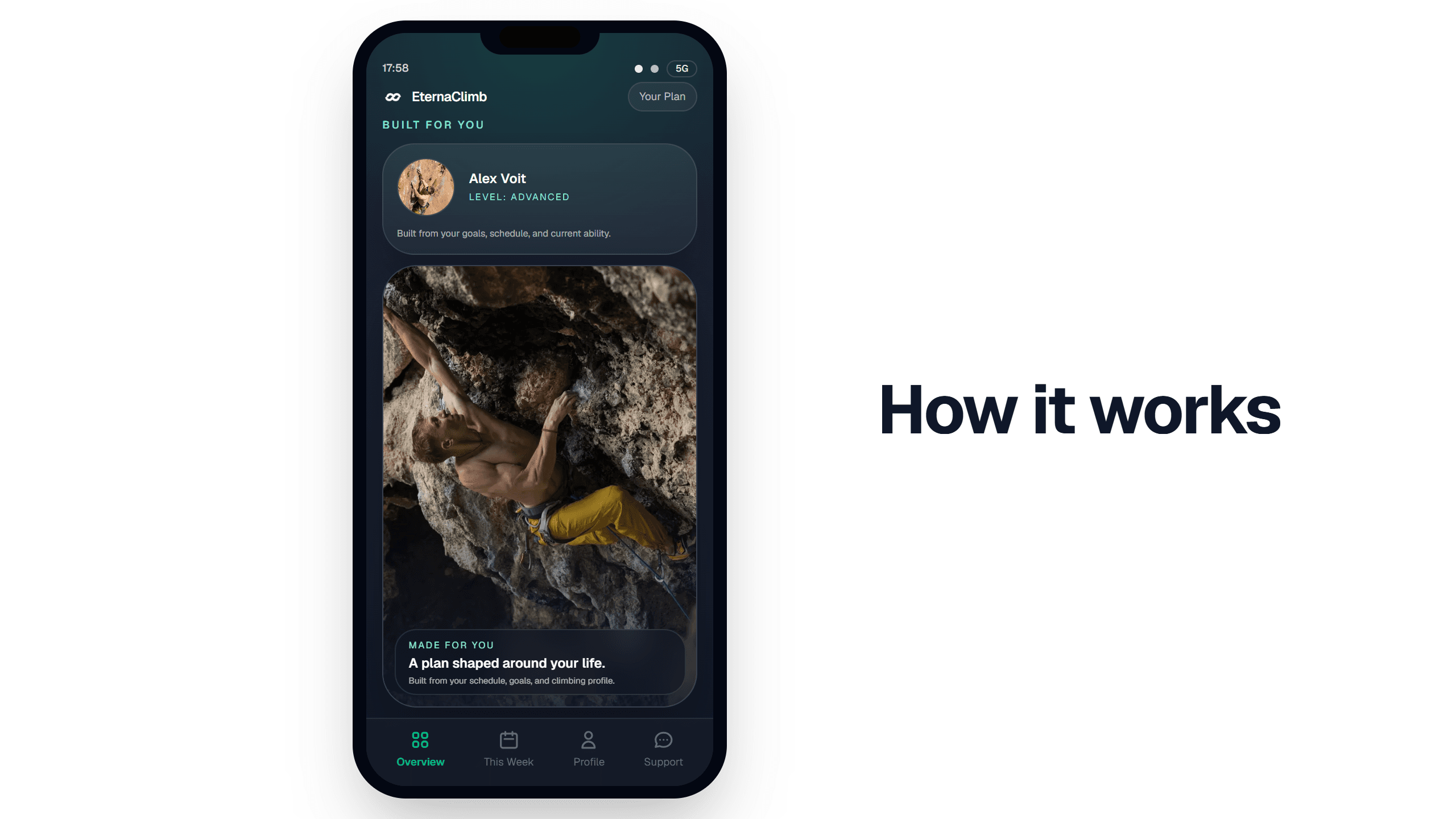
A good climbing plan used to come two ways. A spreadsheet, written once and then frozen while you kept changing. Or a coach entering your corrections every week, for around two hundred dollars a month. Now the adjusting lives in an app. Same knowledge, alive and finally within reach.
High-performance sport has run far ahead. Around every strong athlete stands a whole staff, dozens of methods and devices. Almost none of it reached the regular climber - too complex, too expensive.
I stand on both sides: a coach and a climber, with access to the labs and to people who just want to climb and enjoy it. For a long time I wanted one thing - take all that science and make it simple. That is what our climbing training app is.
Here is where we got to so far.
Who the plan is for
Who this works for
It would be a lie to say the program builds a perfect plan for everyone, at every level, for every goal. It doesn't.
I once sat down and counted how many combinations you actually have to account for. Level, goal, days per week, equipment at home and at the gym, injuries, experience, phase of the cycle, time per session. Multiply it out and it is not tens of thousands of variants. It is hundreds of thousands of profiles, and once you get to picking the actual exercises inside a session, the count runs into the millions.
So let me be straight about who the app already works well for today:
- Your level is roughly V2 to V8 in bouldering (6A to 7B Font) or 5c to 7b on routes (5.9 to 5.12b YDS)
- You climb in the gym, outdoors, at home, or all of it - the algorithm builds around the equipment you actually have
- You are not currently injured: the program finds weak spots and strengthens them, but it is not built for injury rehab
- You train at least twice a week and you want to get better
Who it is not for
- If you just started climbing. At that stage you first need a real person to watch you from the side and fix your technique. Everything else is secondary. A plan helps here mostly to build your physical base alongside.
- If you are already at V9 / 7c and above. There are too many fine details, and for now those are handled only by hand, in one-on-one coaching.
How a plan helps
Discipline and consistency.
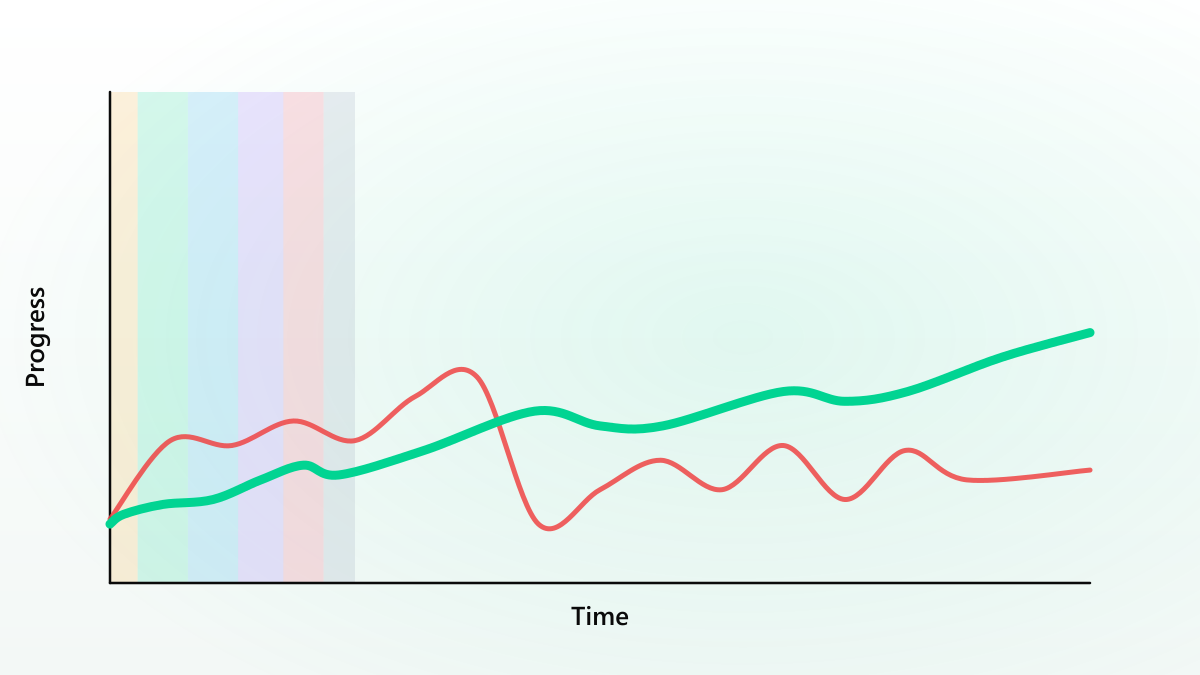
A plan kills the daily question of whether to train. There is a schedule, you just follow it. And over a long stretch, consistency beats motivation. But there is a but: consistency itself runs on motivation, and the two feed each other, like the chicken and the egg.
Less to decide.
You don't have to work out what to do each time. The decision is already made, your head is free for the session itself.
You understand yourself better.
The plan comes with cues and teaches you to read your own load: to tell hard-but-useful from hard-time-to-stop.
Progression handled for you.
Load rises gradually and at the right moment. You don't spin in place for months, and you don't jump a step.
Balance, not just your favorite.
Most people train what already works. A plan makes you close the weak spots: antagonists, core, endurance.
What is inside
Finding your weak link
Before the plan builds anything, it asks one question: what is actually holding you back?
Climbing is not one skill, it is several systems - technique, physical prep, finger strength, mental, and recovery. A plateau usually means one of them fell behind while you kept training what you are already good at. The assessment finds that weak link, and the plan is built to close it. That is where real progress comes from.
An algorithm, not AI. And why
It is fashionable to slap AI on a product. We deliberately don't.
The difference is simple. A neural net is a black box. It gives you an answer but cannot tell you why that one. And sometimes it confidently invents things that do not exist: an exercise that isn't real, a dangerous progression, a weight out of thin air. In a chat that is funny. In training, where your fingers and your back are on the line, it is not acceptable.
A plan no one can explain is not a plan. It is guessing with a confident face.
An algorithm is the opposite. Every exercise is in the program for a reason, and that reason can be said in words. Why fingers on Tuesday and not endurance. Why load drops in week four instead of rising. Why this exercise and not the one next to it. Behind every decision is method, not probability.
This is my logic put into code. You can see it, you can check it. When the algorithm gets something wrong, I find the rule and fix it precisely. You cannot do that with a black box.
I am not against neural nets. They have their strengths. But in training, not today.
A coach reviews it
An algorithm builds the plan. A real coach checks it before it reaches you.
At the review stage the coach reads your quiz answers and tunes the algorithm to your profile. Fast and consistent as it is, the algorithm works on rules, and a rule does not catch everything: a note in your history, an injury you mentioned, a goal that does not quite fit the template. The coach corrects for that, so your plan comes out accurate and personal, with nothing in it you would question. You get both: the speed of the system and the eye of a person.
Adapting to each day
Your body does not live by a schedule in a spreadsheet. One day you slept well and you are fresh, the next you are short on sleep, coming down with something, wound up. A static plan ignores that. A living one doesn't.
Before a session the app looks at two signals. First, how you feel right now: sleep, recovery, readiness. Second, how you are moving through the week's program as a whole. Out of that comes today's call: give the full load, an easier version, or send you to rest.
That is the difference between a note on the fridge and a coach who looks at you before the session. The plan bends to you, instead of you breaking against the plan.
The voice diary
Logging sets and reps is something any app can do. That is standard. But every diary has another side: the feedback between you and your coach about how you actually feel.
You just talk. How it went, how you feel, what tweaked, what flew. The way you would tell a coach on the walk out of the gym.
The voice catches what numbers lose. "My shoulder nagged on the third set." "Felt like a wrung-out lemon today." "Climbed without fear for the first time." No column of reps will ever show that.
Today these notes are a live feedback channel between you and your coach, and a way to notice what would otherwise slip past.
Remember I said I won't trust a neural net to decide what to do with your body? Reading everything you said over a month and spotting a pattern you don't notice yourself - that is exactly its job. Understanding real speech and analytics belong right here.
For us the voice diary is not a checkbox on a feature list. It is the foundation for the plan to truly hear you tomorrow.
A plan built to a date
Training almost always has a target in time. A trip to the crag. A competition. A project you want to send before your holiday.
The app builds the program backward from that point. You say when you need to be in form, and the cycle is laid out so the peak lands on those exact days, not vaguely someday. Base, build, taper, peak - all tied to your calendar, not to the calendar in general.
Training toward a specific date and just training are two different things. The first puts you on the rock in your best shape exactly when it counts.
Your dashboard
All of this lives in one place. You open the app and you don't see a wall of text. You see today's session. What to do right now.
Next to it, the whole week, so you can see the rhythm: where the hard day is, where the easy one, where the rest. Every exercise comes with a description and a video, so you are not guessing how to do a move. There is a built-in timer for interval work, so you are not counting seconds in your head. You log your sets right there - weight, reps, how it felt - with a tap. And load charts show how volume and intensity run across the block.
It is the same spreadsheet I started with years ago. Except now it draws itself.
A library at hand
The plan tells you what to do. The library tells you how.
Inside the app there is a growing set of drills, guides, and articles - footwork, finger care, warming up, reading your own fatigue. When a session calls for something new, the how-to is one tap away, not somewhere on YouTube.
What is next
I won't pretend it is all finished. We are near the start. And honestly, I like that. The beginning always leaves room to grow, even when you feel you have already arrived.
It also keeps you open. To what is new, and to keep moving.
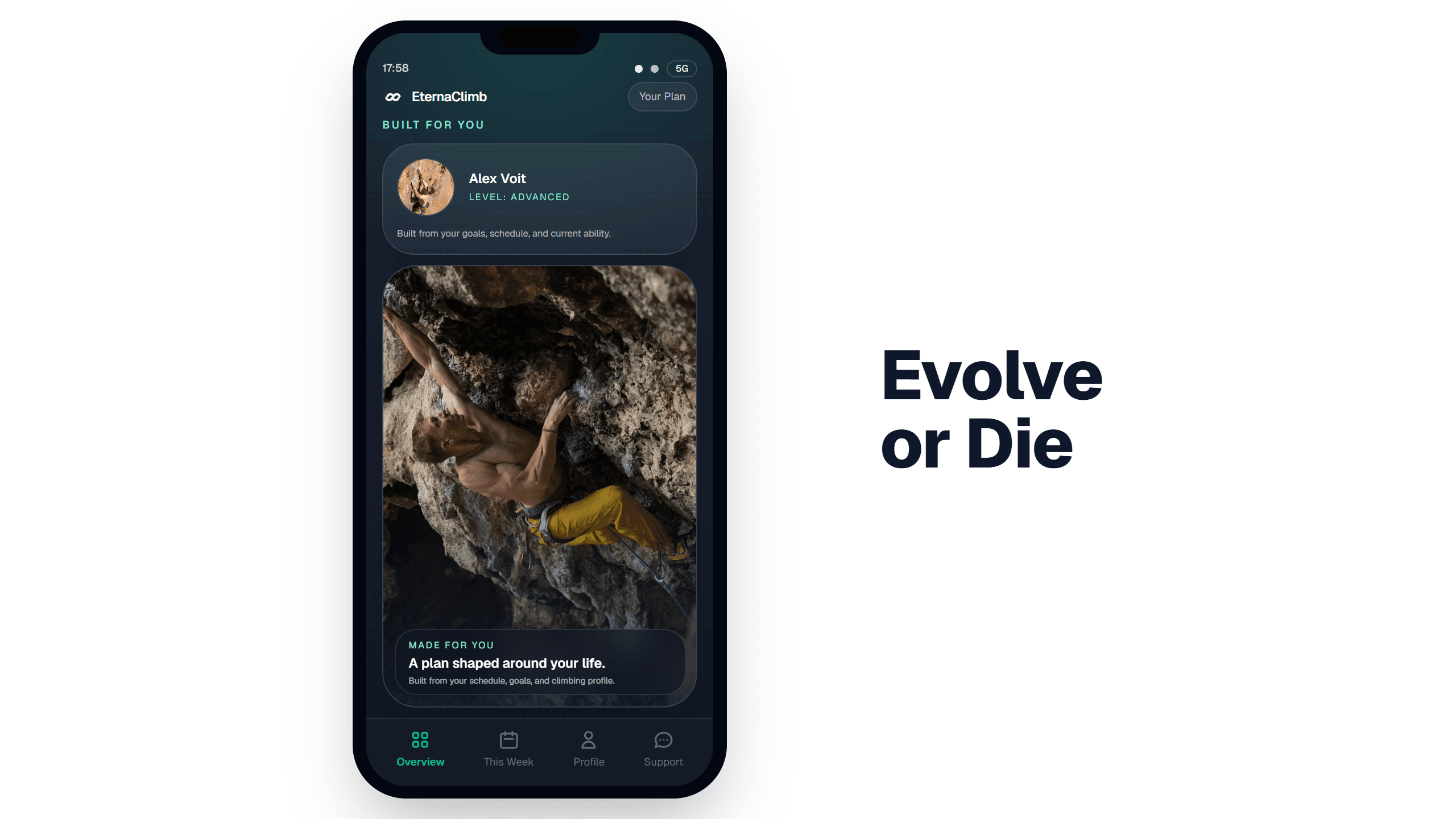
Evolve or die. The plan you follow should be doing the same.
So how do you train right now - to a plan, or by feel?
Not sure it is your case, or what is actually holding you back? The quiz sorts out both in a few minutes.
Get Your Personalized Training Plan