Give a person a fish and they eat once. Give them a rod and teach them to fish, and they feed themselves for life.
This article gives you both. A concrete bouldering training plan for beginners you can run today, and the principles behind it so you understand the training process, progress faster, and stay healthier. Not for one session. For the long run.
Let's start.
A plan is not the point
A good bouldering training plan for beginners is not a harder or more complex plan. Early on, complexity only gets in the way. I have written a lot about combining stimuli, strength, endurance, and periodization. All of it works. But it works once you have been climbing for six months or more. In the beginning it barely helps, because it solves problems you do not have yet.
Nobody needs a plan for the sake of a plan. We want progress. A plan is just a tool for reaching a goal, not the goal itself. So it has to match your goals and what actually limits you. First we figure out what that is. Then we build the week around it.
What actually holds you back
Climbing asks a beginner one main question: how do you move on the wall. That is movement technique. At the start you do not have that knowledge yet, so your climbing is inefficient, and almost every ascent turns into a fight.
Physical strength has almost nothing to do with it. Almost everyone who decides to show up at a climbing gym can already get up their first grades. Strength is not the limiter. That is why separate physical exercises work in the background here. What really holds you back is two things: movement technique and grip and forearm strength. The forearms fail first, and technique decides how much energy you spend on the climb in the first place.
Here is what matters about technique. If you look at the difference between a V0 and a V4, the basic movement principles are essentially the same. First you move your feet in small steps. Then you place them higher and roll your weight onto them. Then you push off the foot, pulling it off the hold or pressing into the wall. Turn the hip, shift your weight onto your feet. All of this is technique, and it barely changes from grade to grade. What changes is how cleanly you can execute it, and how quickly you can find the right movement in a given situation.
So a beginner does not need a complex plan. Your body right now adapts to almost any reasonable stimulus. Splitting training into blocks of strength, power endurance, and ARC is early. Complexity does not speed up progress. It distracts you from the only thing you really need now: move cleanly, a lot, and protect your fingers.
How technique is actually built
Technique is not strength. It is a skill. And a skill gets written into the nervous system by its own rules. They are worth understanding, because the whole structure of training follows from them.
Any motor skill goes through three stages.
Cognitive, the "what do I even do" stage. To work on a movement you need time to think about how to position yourself correctly. And for that you need a reserve of energy. So learning has to happen in an easy setting. On hard problems all of your attention goes to staying on the wall, and almost none is left for learning the movement itself. From that comes the first rule: lots of repetitions, and quality is what drives growth.
Motor, the "do it cleaner" stage. The pattern is there, now it gets refined: fewer wasted movements, smoother weight transfer, more precise feet. Here is the thing to understand: your brain does not care what it memorizes. If you climb sloppy, it records sloppy. If you climb clean, it records clean. So repeat the good attempts, do not grind out the bad ones.
Autonomous, the automatic stage. The movement runs without conscious control, and attention is freed up for difficulty and tactics. For most people at V0-V4 this is still only the most basic movements. The foundation is still being poured. Which is exactly why loading up on complex periodization is early.
From this comes one principle the whole beginner plan rests on: freshness. What gets written in is what you repeat. At your limit and in fatigue you repeat compensations: you hang off your arms, jam your hip into the wall, forget your feet. And the body honestly memorizes that dirty version of the movement. Limit attempts back to back are not just useless for technique. They write the bad pattern in.
That is why every serious attempt at an ascent or a drill needs full rest, at least 2 minutes. So the body recovers a little, and your forearms and your attention are fresh.
Remember one line: at your limit you learn to endure, on freshness you learn to climb.
A simple weekly plan, 2 to 3 times a week
Two or three sessions a week is enough for a beginner to progress fast. The main mistake is making them all the same: walk in, try the hardest thing, repeat until your skin is gone. Give each session its own job. And keep the rule running through everything: you approach your limit on only one day a week, everything else stays sub-maximal, on freshness.
How every session is built (~2 hours)
Every session has the same skeleton. What changes is the climbing in the middle.
| Block | What you do | Time |
|---|---|---|
| Warm-up | General and joints first: light cardio to raise your pulse, then mobilise wrists, fingers, shoulders, and hips. Then activation: scapular pulls and band work for the shoulders. Only then specific: easy climbing working up grade by grade. Never load hard tissue while it is cold. | ~20 min |
| Climbing (the main work) | This is where the day's focus lives (see the table below). | ~60 min |
| Strength in the background | Core, antagonists, pulls. Support work, not the main act. | 20-30 min |
| Cool down / stretch | Wind down calmly. | ~5-10 min |
The three days (the climbing block changes)
| Day | Climbing focus | How to climb it |
|---|---|---|
| Day 1: technique and volume | 6-8 problems below your max or easy ones, focus on movement: quiet feet, weight on your toes, hips to the wall. | Climb each problem 2-3 times. 2 min rest between repeats of the same problem, full rest (3-4 min) before moving to the next one. Quality over how many. |
| Day 2: harder, on freshness (the only limit day) | 4-6 harder problems closer to your limit. | 2-3 real attempts per problem, full rest (3-4 min) between attempts while you are fresh. When technique falls apart, the day is over. |
| Day 3 (if you climb 3x): light volume | Lots of easy problems and traverses, smooth and continuous. | Comfortable pace, no limit. Recovery and movement mileage. Then the main strength block. |
Rest between days matters as much as the sessions themselves. Skill and tissue do not grow during training, they grow in the recovery between sessions. Leave at least one rest day between any two training days. A beginner does not need two bouldering sessions back to back.
| Schedule | How to lay it out |
|---|---|
| 2 times a week | For example Mon and Thu, or Tue and Sat. The point is 2-3 days between sessions. |
| 3 times a week | For example Mon / Wed / Fri. Always at least one rest day between sessions, with two recovery days over the weekend. |
Notice that only one day is built around your limit. That is on purpose. Hard bouldering is the most stressful thing you can do to fingers and elbows. One clear hard day, surrounded by lower-intensity volume, lets you push without breaking down.
And one more thing: in the first months your grip is built by climbing on varied holds, not by a board. Targeted finger work comes later, once you have a base.
What not to rush
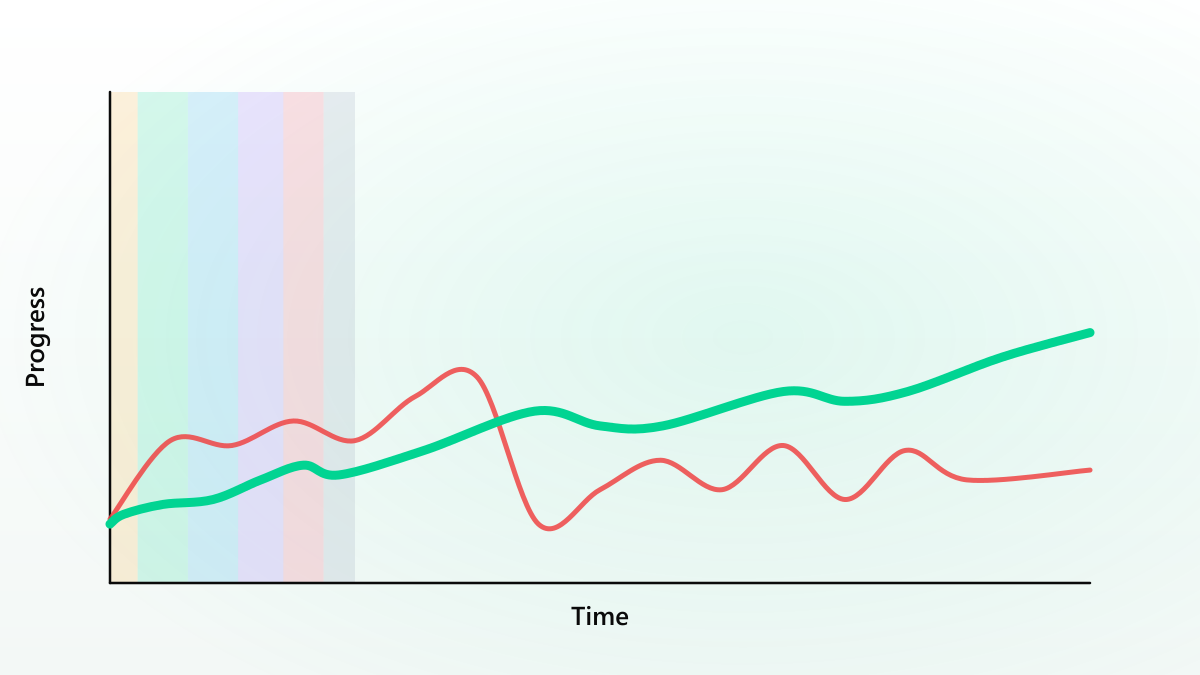
Bouldering pulls you toward advanced-looking training fast. Hangboards, campus boards, limit sessions every day. But your fingers, elbows, and shoulders need time to adapt, and they adapt slower than your enthusiasm grows. Pulling strength and motivation rise quickly. Tendons and the finger pulleys rise slowly. That gap is exactly where first-year injuries land.
- Do not hangboard hard in your first months. The wall is enough finger load.
- No campus board for a beginner. It is impact load on the fingers with no tissue reserve.
- Do not make every session a limit day.
- Do not skip rest days just because you feel fine. Tendons lag behind muscles.
- Do not confuse trashed skin and fatigue with progress.
If something hurts in a sharp, specific spot, back off and do not tough it out. Beginner finger and elbow injuries almost always come from too much intensity too soon, not from too little training.
Consistency wins, but you still need to know what to do
Consistency is not a motivational phrase. It is a structural fact. The boulderer who shows up twice a week and adds a little each time will always pass the one who trains in bursts and disappears.
But staying consistent is hard when you do not know what to do today. When every session starts with "what should I work on?" you default to the comfortable problems, avoid the hard ones, and repeat the same thing. That is not training. That is just bouldering.
A structured plan removes that friction. Every session has a focus. The week is balanced: volume, one hard day, and general strength in the background. You show up, follow the session, and let the process do the work.
How do you build your own week on the wall?
Don't want to build the structure yourself?
Get Your Personalized Training Plan