"Use your feet."
That is the first thing almost every climber hears after the safety briefing. Before grades, before training plans, before anything else. These footwork drills for beginners are how you actually do that, instead of nodding at the advice and going back to pulling with your arms.
Let me explain quickly why it matters and why it does not click right away, then give you the drills.
Why we talk about feet so much
Your legs are stronger than your arms. You carry your bodyweight on your legs every day, and you put far less of it on your hands. So your arms are simply weaker, and they get tired fast.
The job in every move is to put as much weight as possible on your feet and take it off your hands. Not just to stand on your feet, but to push off them toward the next hold. Unless you are doing campus moves, and those start showing up at an advanced level, almost every beginner move starts from the feet. Call it 99% of them.
That is the whole reason we talk about feet so much: it is what makes your climbing efficient and saves you a ton of energy.
Why it is harder than it looks
Here is the honest part. This is a coordination problem, not a strength problem.
If you ever learned to drive a manual car, you remember the first time: right hand on the gearstick, left hand on the wheel, both feet working the pedals, all at once, and somehow it has to become one smooth action. Climbing is that, except the number of variations is endless and your brain has to manage all of it while you are on the wall.
So when you watch a video or read an article like this, your first reaction is "that looks simple." On the wall it is not. Some single moves take hours of practice to wire in, and mastering your body overall takes hundreds. That is normal. Do not rush it.
Drill 1: place your foot on the toe
This one is less a drill and more a rule that sits under everything else. Put your foot on the hold with the toe, the front of the shoe, not the middle of your foot. When you stand on the toe, you can turn your body, drop a knee, and shift your hips freely. The foot becomes a pivot.
The common mistake: planting the foot flat or sideways. Now your body is locked. You either cannot turn, or you slip off the moment you try.
Drill 2: keep your eyes on the foot until it lands
Watch your foot all the way onto the hold. Do not look away until it is set. The whole placement, start to finish, stays under your eyes.
At first this feels slow and strange. You will spend what feels like forever staring at your shoes. Good. Over time it shrinks to a quick glance, and that glance is enough. Your confidence in your feet goes up several times over.
The common mistake: looking away at the last second, right before the foot lands, or not looking at all. That is exactly when feet slip.
Drill 3: climb silently
Place your feet as quietly as you can. No tapping, no scraping, not a single knock against the hold or the wall. Silent feet.
Why it works: you cannot be silent and careless at the same time. To make no sound you have to place the foot with intention, control the weight, and commit. Noise is just feedback that you dropped your foot instead of placing it.
Drill 4: take footwork off the wall
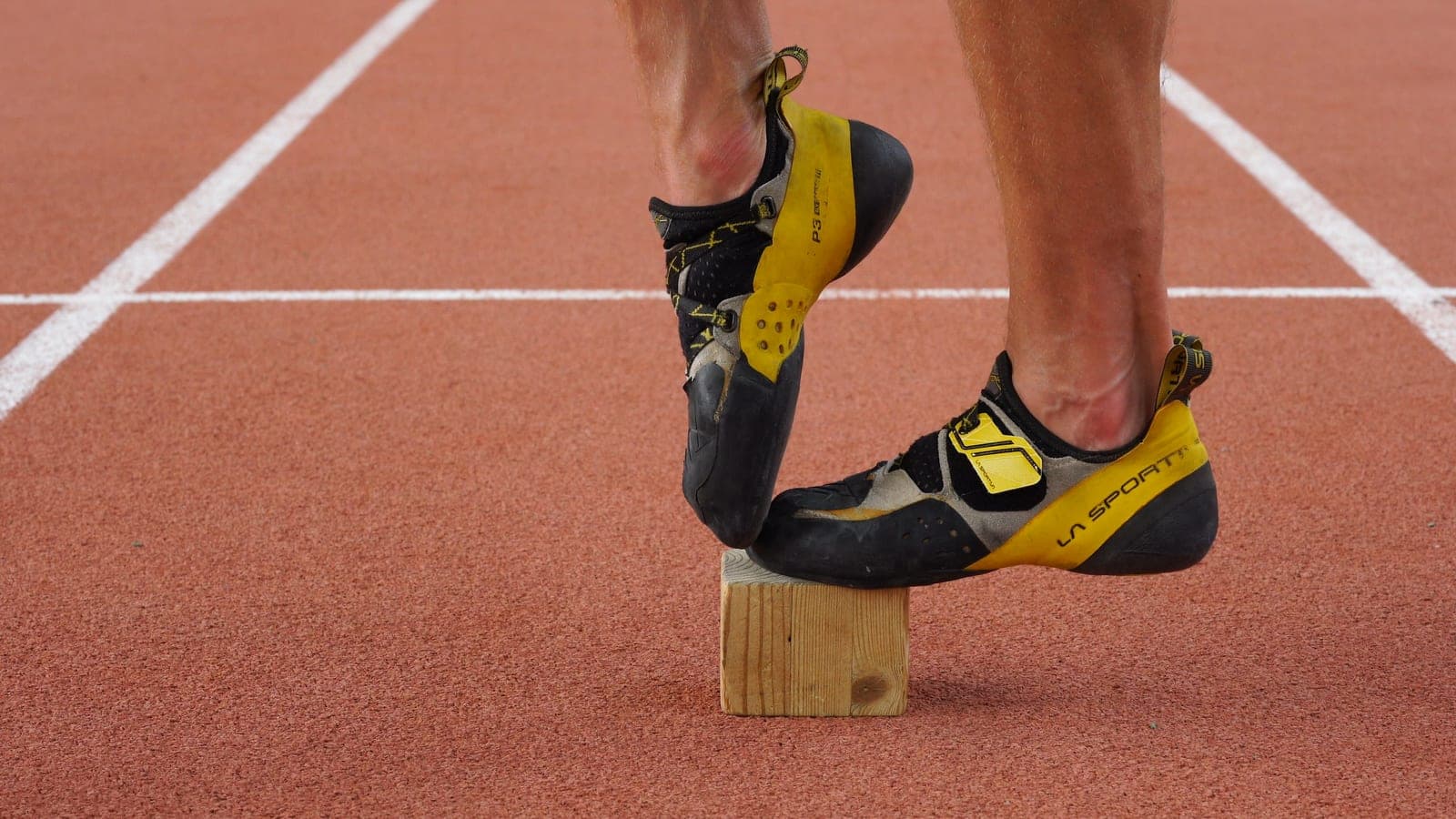
On the wall your forearms pump fast, and once they are gone the lesson is over. So isolate footwork from the wall. You do not need a wall to train balance and foot precision. A few holds, blocks, or small objects on the floor are enough: stand on them, shift your weight, catch your balance, move between them.
I have a whole set of these on small blocks, built for footwork and coordination, in the exercise library. They let you train the skill when your fingers are too tired to climb, which is most of the time.
Drill 5: downclimb everything
The easiest way to expose lazy feet is to climb back down what you just climbed up. You cannot throw your way down. You are forced to look, place, and trust each foot before you weight it. Downclimb easy routes you have already sent. It is the most boring drill here, and the one that changes the most.
Drill 6: stop readjusting your feet
Once your foot is on the hold, leave it there. No shuffling, no little corrections, no searching for a better spot. You place it, you commit, and you move your body around it.
This is a cousin of silent feet and watching the foot, but it trains a different thing: not how you place the foot, but trusting it afterward. Beginners set a foot and then fidget with it for the whole move. Every adjustment is a small slip waiting to happen, and energy you pay for with your arms.
The common mistake: readjusting the foot mid-move because you do not trust the first placement. Fix the trust at the source - place it once, deliberately, then forget about it and let the foot work.
Drill 7: inside and outside edge
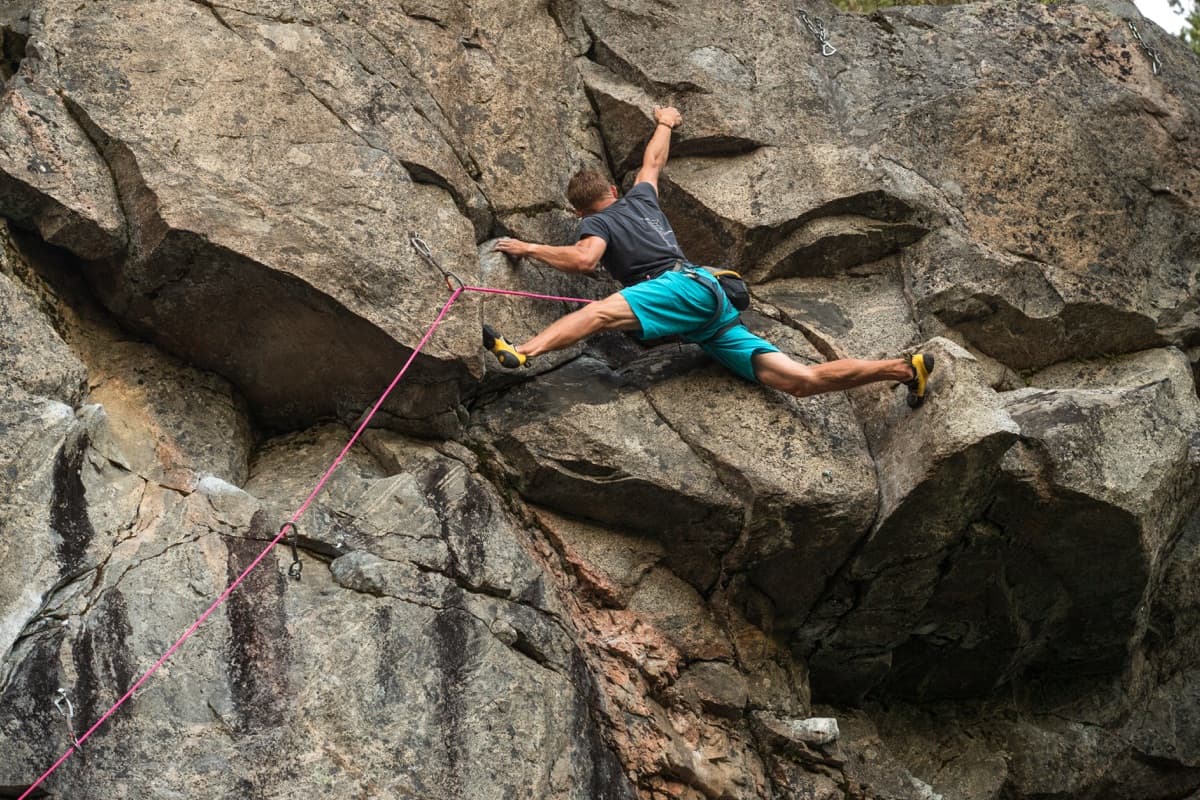
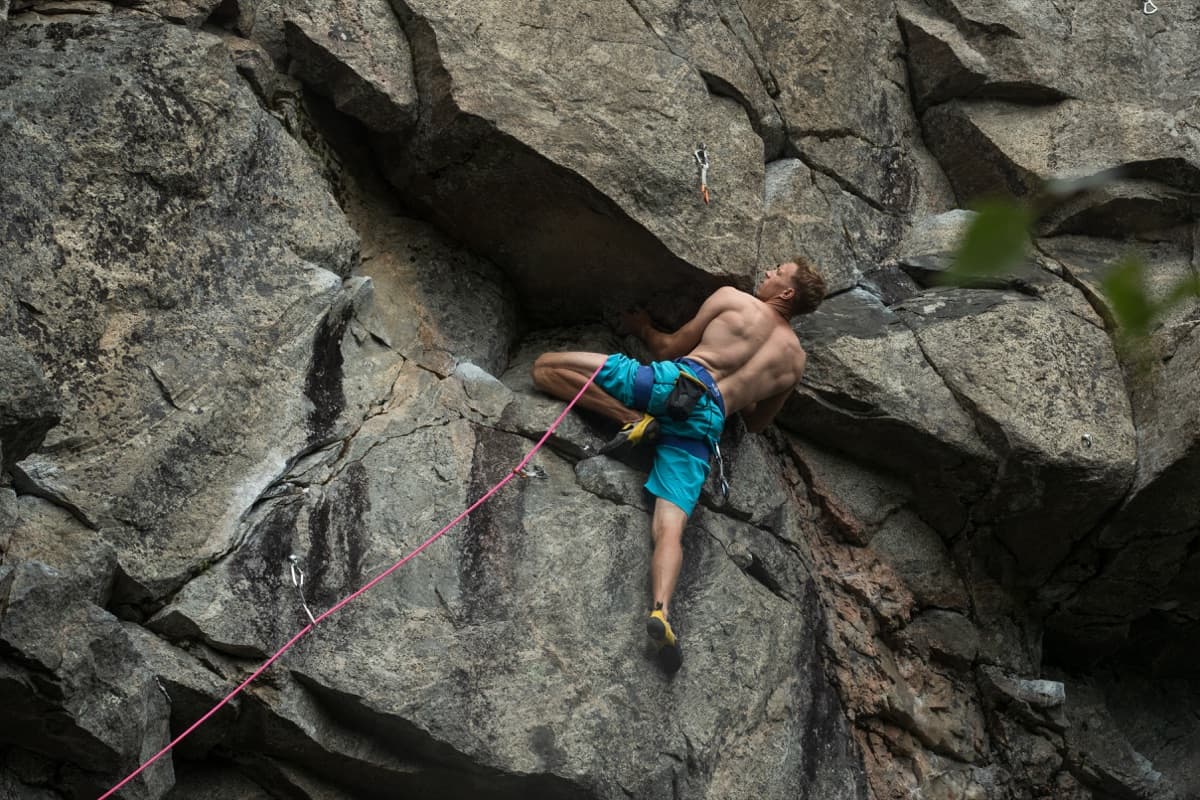
The shoe is not only a toe. The inside edge, the big-toe side, gives you a powerful platform and turns your hips into the wall. The outside edge, the little-toe side, opens up the backstep and the drop knee, turning your hip away from the wall. Take an easy route and climb it deliberately choosing an edge for each move.
The common mistake: always placing the foot the same way, however it lands. Then your body never turns, and you pull with your arms what you could have pressed up with a leg.
Drill 8: smearing, stand on friction
There is not always a foothold. Learn to stand on friction: put as much rubber on the wall as you can, press straight down through the toe, and do not paw at it. This is mostly about slabs and low-angle walls. At first it feels terrifying, like nothing is holding. It holds, if you press with your weight instead of clawing.
The physics that matters most here is the amount of force and its angle. Press perpendicular into the plane of the wall and the foot holds you. The moment your torso drifts and your line of force shifts with your center of gravity, the foot slides, even with the whole sole on the rock, because the force is no longer going into the plane but along it.
Drill 9: swap feet on one hold
Place a foot, then swap it for the other foot on the same hold, without noise and without losing balance. On a small foothold this is its own skill: lift slightly, clear it, place the other one exactly. It trains precision and balance at the same time.
The common mistake: swapping with a little hop that breaks contact. Do it smoothly, through a touch.
Drill 10: flag, the free leg for balance
When there is no hold for the second foot, do not hunt for one in a panic and do not hang off your arms. Swing the free leg out to the side as a counterweight, a flag. It holds nothing, it balances you over the standing foot. Try it on easy traverses: one leg works, the other balances.
Lifehack: press the free foot flat against the wall even where there is no hold. Friction alone gives you something to hold position with, and you can still push off the wall to move.
Where to start
None of this is about strength. It is about paying attention to the half of your body most beginners forget they have.
Pick one drill. Use it for your next three sessions, not for five minutes today. The body learns footwork by repetition, not by reading.
So, next time you climb, where are your eyes going to be?
Want footwork built into a full training plan?
Get Your Personalized Training Plan